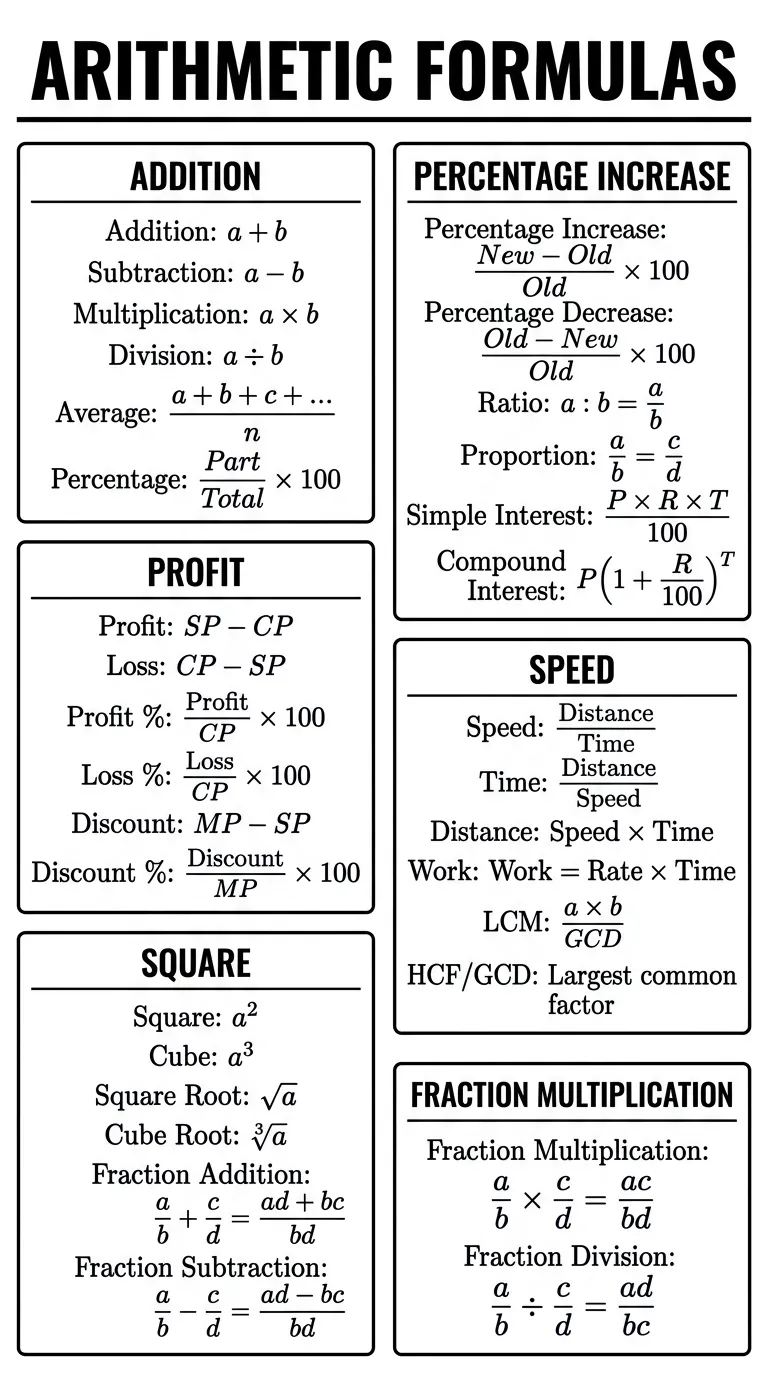
The arithmetic formula cheat sheet gives a clear list of basic math formulas, including addition, percentages, fractions, averages, and number rules, helping students solve daily calculations quickly and with better accuracy.
Conclusion
The simplest and most fundamental branch of mathematics, which involves numbers and the simplest of operations such as addition, subtraction, multiplication, and division, is arithmetic. It is the preliminary step to becoming familiar with the functionality of numbers in our daily life. Arithmetic is important in everyday activities, from counting objects to handling finances. It assists in establishing a good base to further mathematical concepts like algebra and calculus. We also study fractions, decimals, percentages, and ratios in arithmetic, which are often used in the real world in shopping, banking, and measurements.
Knowledge of arithmetic enhances problem-solving and logical thinking. Not only is it important to students, but also helpful to professionals in such areas as finance, engineering, and business. Arithmetic also brings about other concepts, such as place value, patterns of numbers, and rudimentary equations, simplifying complicated calculations in the future. Arithmetic should be learned in a simple and orderly manner, which will contribute to the building of confidence when it comes to numbers. Generally, arithmetic is the foundational stage of mathematics, underpins all other concepts, and supports accuracy in daily calculations.
In conclusion, arithmetic is the backbone of mathematics that helps us handle numbers easily in daily life. A strong understanding of arithmetic makes learning advanced topics simpler and more effective.
Trigidentities.net is a participant in the Amazon Services LLC Associates Program, an affiliate advertising program designed to provide a means for sites to earn advertising fees by advertising and linking to Amazon.com