

The arithmetic sequence formula is an important concept in algebra that helps represent numbers using symbols and letters. An arithmetic progression formula allows us to write mathematical ideas in a simple and flexible form. In an arithmetic progression formula, letters like x, y, or z are used to show unknown values, while numbers and operations define relationships. Learning the arithmetic progression formula makes it easier to understand patterns and solve equations. A linear sequence formula is widely used in real-life situations such as calculating costs, measuring quantities, and solving problems step by step. By practising the linear sequence formula, students develop logical thinking and problem-solving skills.
Arithmetic Sequence Formula
Arithmetic Sequence Formula
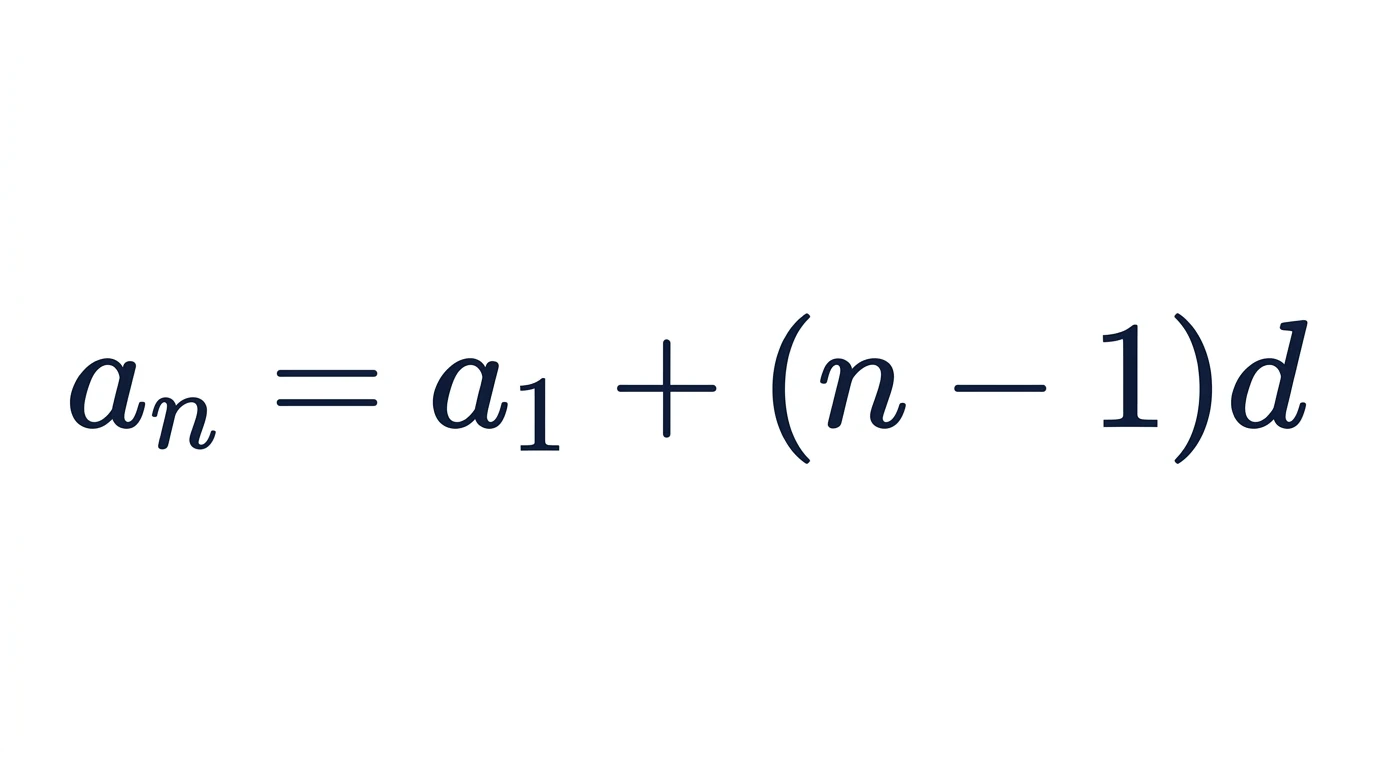
The nth term of an arithmetic sequence is given by:
a_n = a_1 + (n – 1)d,
where a_1 is the first term, d is the common difference, and n is the term number.
Arithmetic Sequence Formula
An arithmetic sequence is a sequence of numbers in which the difference between consecutive terms remains constant. This constant value is known as the common difference. Arithmetic sequences are commonly used in mathematics, finance, statistics, and everyday calculations.
What Is an Arithmetic Sequence?
An arithmetic sequence follows the pattern:
a, a + d, a + 2d, a + 3d, a + 4d, …
where:
- a = first term
- d = common difference
- n = term number
Example
2, 5, 8, 11, 14, …
In this sequence:
- First term (a) = 2
- Common difference (d) = 3
Each term is obtained by adding 3 to the previous term.
Arithmetic Sequence Formula
The formula for finding the nth term of an arithmetic sequence is:
aₙ = a + (n − 1)d
where:
- aₙ = nth term
- a = first term
- d = common difference
- n = position of the term
This formula helps you find any term directly without listing all the previous terms.
How to Find the Common Difference
The common difference is calculated by subtracting a term from the next term:
d = Term₂ − Term₁
Example
Sequence:
7, 12, 17, 22, 27, …
d = 12 − 7 = 5
So, the common difference is 5.
Mathematical Proof of Arithmetic Sequence Formula
1. ARITHMETIC SEQUENCE NTH TERM (a_n = a_1 + (n-1)d)
Definition:
An arithmetic sequence is a sequence where each term differs from the previous by a constant amount d, called the common difference.
Proof Idea:Starting from a_1, we add d once to get a_2 = a_1 + d, twice to get a_3 = a_1 + 2d, and so on. To reach the nth term, we add d exactly (n-1) times: a_n = a_1 + (n-1)d. By induction: base case a_1 holds; if a_k = a_1 + (k-1)d, then a_(k+1) = a_k + d = a_1 + (k-1)d + d = a_1 + kd.
Example:Sequence 3, 7, 11, 15, … has a_1 = 3 and d = 4. The 10th term is a_10 = 3 + (10-1)·4 = 3 + 36 = 39.
Properties:a_n – a_(n-1) = d for all n > 1
Any three consecutive terms satisfy: a_(n+1) – a_n = a_n – a_(n-1)
a_n = a_m + (n – m)d for any m, n
The arithmetic sequence formula allows direct calculation of any term by adding the first term to the common difference multiplied by the number of steps from the first term.
Other Names of Arithmetic Sequence Formula
Conclusion
In conclusion, Common Difference Sequence plays a key role in learning algebra and understanding mathematical relationships. A AP nth Term Formula helps represent unknown values and makes problem-solving more flexible. With regular practice, AP nth Term Formula becomes easy to use in equations and real-life situations. It also builds a strong base for advanced topics like functions and algebraic equations. Mastering AP nth Term Formula improves logical thinking and makes calculations more structured. Overall, Arithmetic Progression Formula in algebra is an essential concept that helps students grow in mathematics and confidently handle different types of algebra problems.