

Logarithm Definition is an important concept in algebra that helps represent numbers using symbols and letters. A Log Base Definition allows us to write mathematical ideas in a simple and flexible form. In a Log Base Definition, letters like x, y, or z are used to show unknown values, while numbers and operations define relationships. Learning Log Base Definition makes it easier to understand patterns and solve equations. A Basic Logarithm Definition is widely used in real-life situations such as calculating costs, measuring quantities, and solving problems step by step. By practicing Basic Logarithm Definition, students develop logical thinking and problem-solving skills.
A Fundamental Logarithm Property can include constants, variables, and operations like addition, subtraction, multiplication, and division. Understanding Fundamental Logarithm Property is the first step toward solving algebraic equations and working with functions. It also helps in simplifying complex problems into manageable forms. A Basic Logarithm Definition is not just about symbols, but about understanding how quantities change and relate to each other. With strong knowledge of Fundamental Logarithm Property, learners can easily move to advanced algebra topics. Overall, Logarithmic Form is a key building block in algebra that supports deeper mathematical understanding.
Logarithm Definition
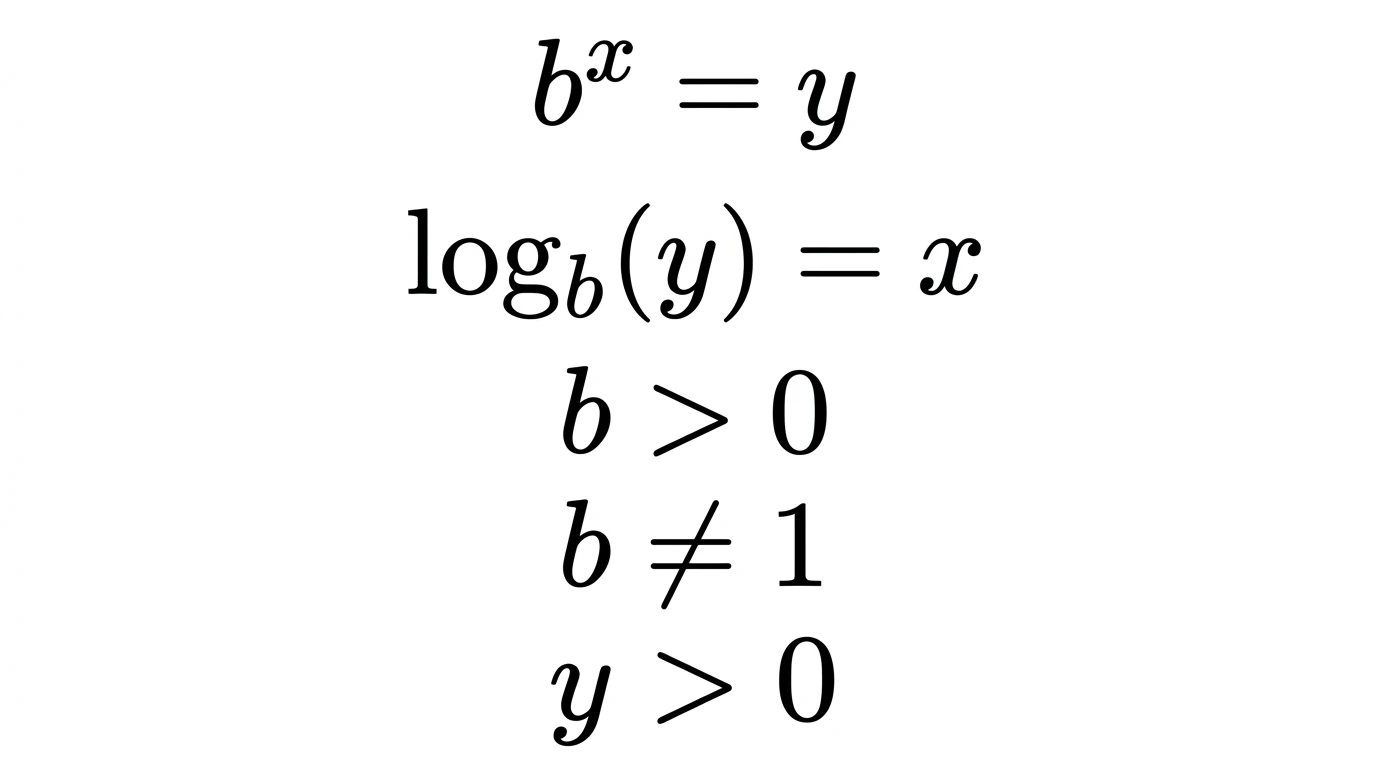
Logarithm Definition Formula
logba = c ⇔ bc = a
Mathematical Proof of Logarithm Definition
1. LOGARITHM (logᵦ x)
Definition:
A logarithm answers the question: To what power must we raise base b to obtain x?
Proof Idea:Consider log₂(8) = y. This asks: 2 raised to what power equals 8? Since 2³ = 8, we have y = 3, so log₂(8) = 3. The logarithm converts multiplication problems into addition problems by working with exponents.
Example:log₁₀(100) = 2 because 10² = 100 log₃(27) = 3 because 3³ = 27 log₅(1) = 0 because 5⁰ = 1 log₂(1/4) = -2 because 2⁻² = 1/4
Properties:logᵦ(bˣ) = x (logarithm undoes exponentiation)
bˡᵒᵍᵇ⁽ˣ⁾ = x (exponentiation undoes logarithm)
logᵦ(1) = 0
logᵦ(b) = 1
Domain: x > 0, Range: all real numbers
Logarithms are the inverse operation of exponentiation, allowing us to solve for unknown exponents and transform multiplicative relationships into additive ones.
Other Names of Logarithm Definition
Conclusion
Logarithmic Form plays a key role in learning algebra and understanding mathematical relationships. A Basic Logarithm Definition helps represent unknown values and makes problem-solving more flexible. With regular practice, Basic Logarithm Definition becomes easy to use in equations and real-life situations. It also builds a strong base for advanced topics like functions and algebraic equations. Mastering Basic Logarithm Definition improves logical thinking and makes calculations more structured. Overall, Log Base Definition in algebra is an essential concept that helps students grow in mathematics and confidently handle different types of algebra problems.
FAQs
1. Why is the logarithm definition formula used?
It helps simplify logarithmic calculations in mathematics.
2. Where is the logarithm definition formula applied?
It is used in scientific computing and algebra.
3. Is the logarithm definition formula important for students?
Yes, it is essential for competitive math prep and learning.
4. Does the logarithm definition formula help solve equations?
Yes, it simplifies logarithmic equations effectively.
5. Is the formula used in higher mathematics?
Yes, it is common in algebra formulas and advanced topics.