

The change of base formula is an important concept in algebra that helps represent numbers using symbols and letters. A Base Conversion Formula allows us to write mathematical ideas in a simple and flexible form. In a Base Conversion Formula, letters like x, y, or z are used to show unknown values, while numbers and operations define relationships. Learning Base Conversion Formula makes it easier to understand patterns and solve equations. A Log Base Change Rule is widely used in real-life situations such as calculating costs, measuring quantities, and solving problems step by step. By practicing Log Base Change Rule, students develop logical thinking and problem-solving skills.
A Logarithm Base Transformation can include constants, variables, and operations like addition, subtraction, multiplication, and division. Understanding Logarithm Base Transformation is the first step toward solving algebraic equations and working with functions. It also helps in simplifying complex problems into manageable forms. A Log Base Change Rule is not just about symbols, but about understanding how quantities change and relate to each other. With strong knowledge of Logarithm Base Transformation, learners can easily move to advanced algebra topics. Overall, Change of Base Theorem is a key building block in algebra that supports deeper mathematical understanding.
Change of Base Formula
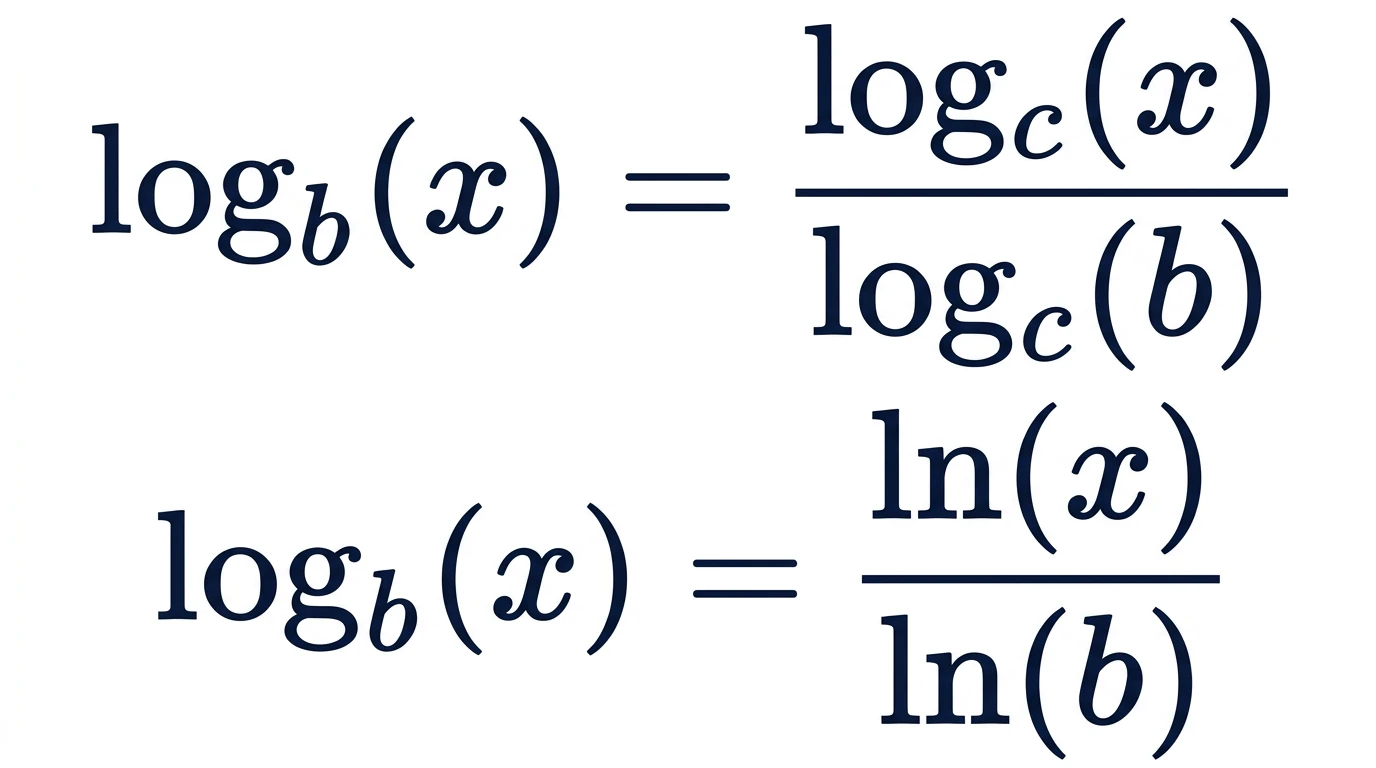
Change of Base Formula
logba = logca logcb
Mathematical Proof of Change of Base Formula
1. CHANGE OF BASE FORMULA (log_b(x) = log_a(x) / log_a(b))
Definition:
The Change of Base Formula allows conversion of a logarithm in any base to a quotient of logarithms in a different base.
Proof Idea:Let y = log_b(x), which means b^y = x. Taking log_a of both sides: log_a(b^y) = log_a(x). Using the power rule: y·log_a(b) = log_a(x). Solving for y: y = log_a(x) / log_a(b). Therefore log_b(x) = log_a(x) / log_a(b).
Example:log_2(100) = log_10(100) / log_10(2) = 2 / 0.301 ≈ 6.644. Also log_2(100) = ln(100) / ln(2) ≈ 6.644
The new base a can be any positive number except 1
Commonly used to convert to base 10 (common logarithms) or base e (natural logarithms)
log_b(b) = log_a(b) / log_a(b) = 1, confirming the formula’s consistency
The Change of Base Formula enables calculation of logarithms in any base using calculators that only support common or natural logarithms, unifying logarithmic computation across all bases.
Other Names of Change of Base Formula
Conclusion
The Change of Base Theorem plays a key role in learning algebra and understanding mathematical relationships. A Base Conversion Formula helps represent unknown values and makes problem-solving more flexible. With regular practice, Base Conversion Formula becomes easy to use in equations and real-life situations. It also builds a strong base for advanced topics like functions and algebraic equations. Mastering Base Conversion Formula improves logical thinking and makes calculations more structured. Overall, Base Conversion Formula in algebra is an essential concept that helps students grow in mathematics and confidently handle different types of algebra problems.
FAQs
1. What is the Change of Base Formula?
It converts a logarithm from one base to another.
2. Why is the change of base formula used?
It simplifies logarithmic calculations using standard calculator bases.
3. Where is it used?
It is used in scientific computing and mathematics problems.
4. Is it important for exams?
Yes, it is commonly used in competitive math prep and exams.
5. Why is the change of base formula important?
It simplifies calculations and improves problem-solving speed.