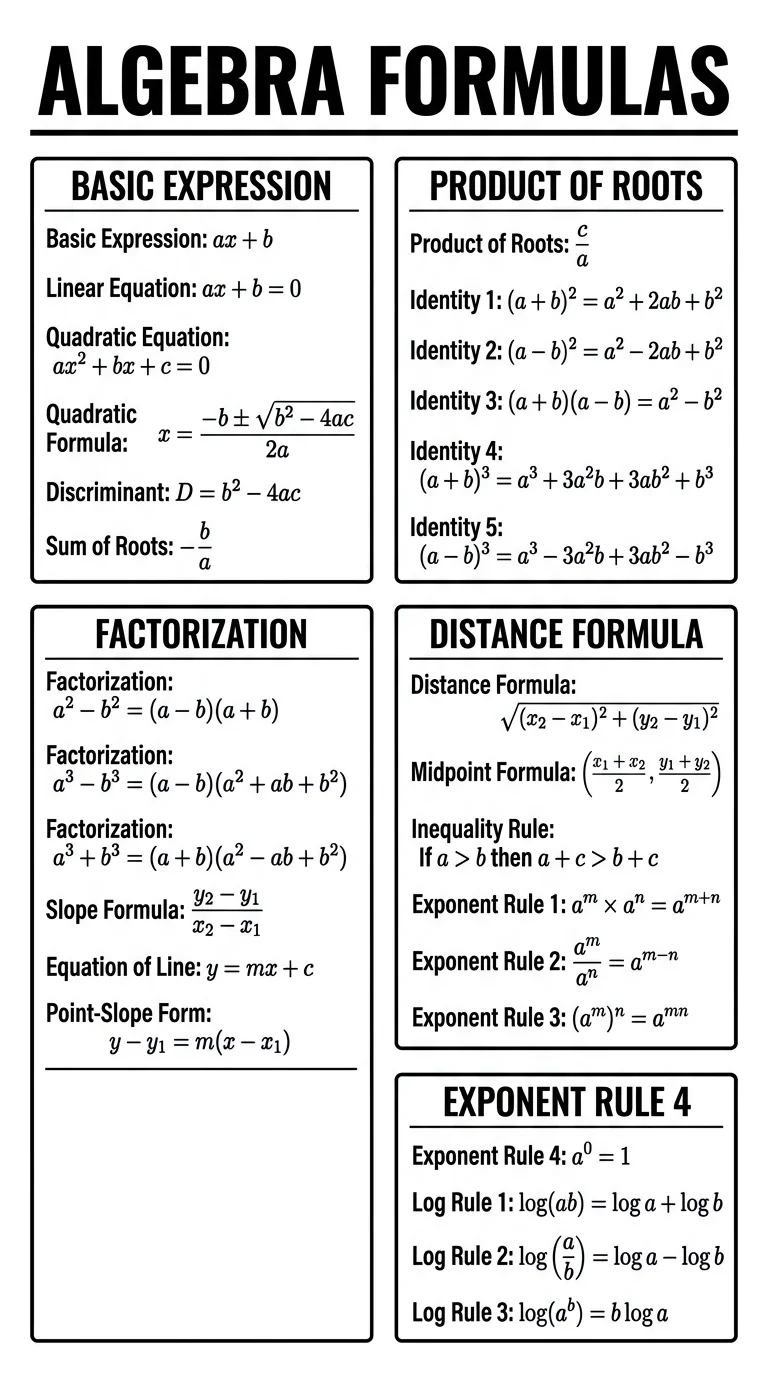
Algebra Formula Cheat Sheet with Identities and Rules
Algebra formula cheat sheet covers important algebra formulas, identities, equations, and expressions, making it easier to simplify problems, solve variables, and understand relationships between numbers in a simple way.
Conclusion
Algebra is a sub-field of mathematics that involves the use of symbols, variables and equations to represent and solve problems. Algebra enables us to generalize patterns and relationships, as opposed to working with numbers only. It is used in the expression of values which are unknown by letters and to solve equations to determine the unknown values. Algebra finds a lot of application in life like budgeting, planning, engineering and data analysis. It also presents such concepts as expressions, linear equations, inequalities, functions, and polynomials.
Studying algebra enhances logical thinking and problem solving skills since it involves having knowledge of relations between various quantities. It is also an intermediary between simple arithmetic and more advanced mathematical fields such as calculus and statistics. Algebra finds application in many areas such as science, technology, economics, and computer programming. Students learn to think abstractly and can solve complicated problems step by step by practicing algebra. It is also useful in identification and prediction of trends on the basis of data presented. On the whole, algebra is a very strong mathematical instrument that makes real life issues easy to solve and ready learners to further learning.
In summary, algebra plays a key role in understanding mathematical relationships and solving real-world problems. It builds strong analytical skills and forms the foundation for advanced mathematical learning.
Trigidentities.net is a participant in the Amazon Services LLC Associates Program, an affiliate advertising program designed to provide a means for sites to earn advertising fees by advertising and linking to Amazon.com