

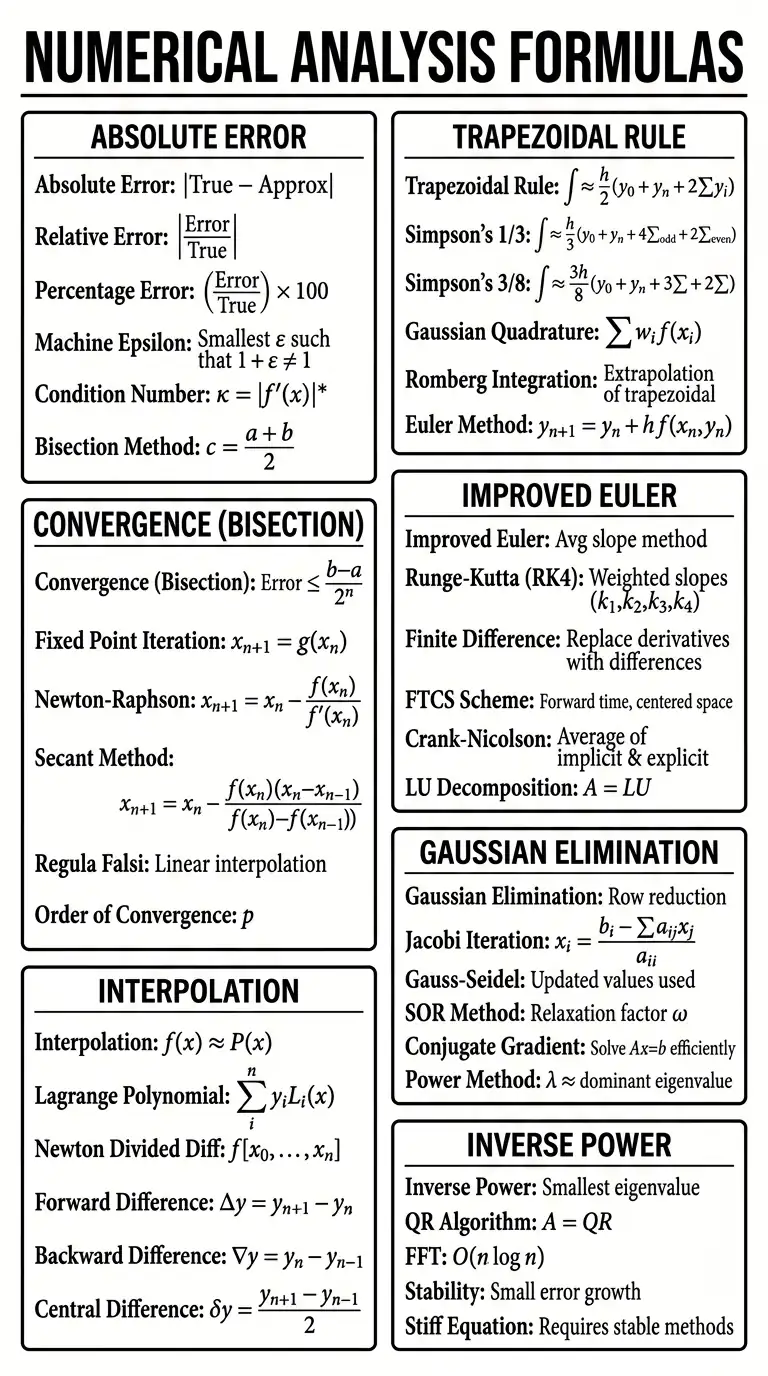
Numerical Analysis Formula Cheat Sheet
| Topic | Formula | Description |
|---|---|---|
| Absolute Error | |True − Approx| | Difference from exact value |
| Relative Error | |Error / True| | Accuracy measure |
| Percentage Error | (Error/True) × 100 | Error in percent |
| Machine Epsilon | Smallest ε such that 1+ε ≠ 1 | Precision limit |
| Condition Number | κ = |f′(x)|* | x/f(x) |
| Bisection Method | c = (a+b)/2 | Root by halving interval |
| Convergence (Bisection) | Error ≤ (b−a)/2ⁿ | Accuracy bound |
| Fixed Point Iteration | xₙ₊₁ = g(xₙ) | Iterative method |
| Newton-Raphson | xₙ₊₁ = xₙ − f(xₙ)/f′(xₙ) | Fast root finding |
| Secant Method | xₙ₊₁ = xₙ − f(xₙ)(xₙ−xₙ₋₁)/(f(xₙ)−f(xₙ₋₁)) | No derivative |
| Regula Falsi | Linear interpolation | Bracketing method |
| Order of Convergence | p | Speed of convergence |
| Interpolation | f(x) ≈ P(x) | Approximate function |
| Lagrange Polynomial | Σ yᵢLᵢ(x) | Interpolation formula |
| Newton Divided Diff | f[x₀,…,xₙ] | Recursive interpolation |
| Forward Difference | Δy = yₙ₊₁ − yₙ | Discrete difference |
| Backward Difference | ∇y = yₙ − yₙ₋₁ | Reverse difference |
| Central Difference | δy = (yₙ₊₁ − yₙ₋₁)/2 | Symmetric difference |
| Trapezoidal Rule | ∫ ≈ (h/2)(y₀ + yₙ + 2Σyᵢ) | Integration |
| Simpson’s 1/3 | ∫ ≈ (h/3)(y₀ + yₙ + 4Σodd + 2Σeven) | Better approx |
| Simpson’s 3/8 | ∫ ≈ (3h/8)(y₀ + yₙ + 3Σ + 2Σ) | Cubic approx |
| Gaussian Quadrature | Σ wᵢ f(xᵢ) | Weighted integration |
| Romberg Integration | Extrapolation of trapezoidal | High accuracy |
| Euler Method | yₙ₊₁ = yₙ + h f(xₙ,yₙ) | Basic ODE solver |
| Improved Euler | Avg slope method | Better Euler |
| Runge-Kutta (RK4) | Weighted slopes (k₁,k₂,k₃,k₄) | High accuracy ODE |
| Finite Difference | Replace derivatives with differences | PDE solving |
| FTCS Scheme | Forward time, centered space | Heat equation |
| Crank-Nicolson | Average of implicit & explicit | Stable scheme |
| LU Decomposition | A = LU | Solve linear systems |
| Gaussian Elimination | Row reduction | Solve equations |
| Jacobi Iteration | xᵢ = (bᵢ − Σaᵢⱼxⱼ)/aᵢᵢ | Iterative solver |
| Gauss-Seidel | Updated values used | Faster iteration |
| SOR Method | Relaxation factor ω | Accelerated method |
| Conjugate Gradient | Solve Ax=b efficiently | Large systems |
| Power Method | λ ≈ dominant eigenvalue | Eigenvalue method |
| Inverse Power | Smallest eigenvalue | Eigenvalue method |
| QR Algorithm | A = QR | Eigenvalue computation |
| FFT | O(n log n) | Fast transform |
| Stability | Small error growth | Reliable method |
| Stiff Equation | Requires stable methods | ODE difficulty |
Visited 11 times, 1 visit(s) today