

Linear Algebra Formula Cheat Sheet
| Topic | Formula | Description |
|---|---|---|
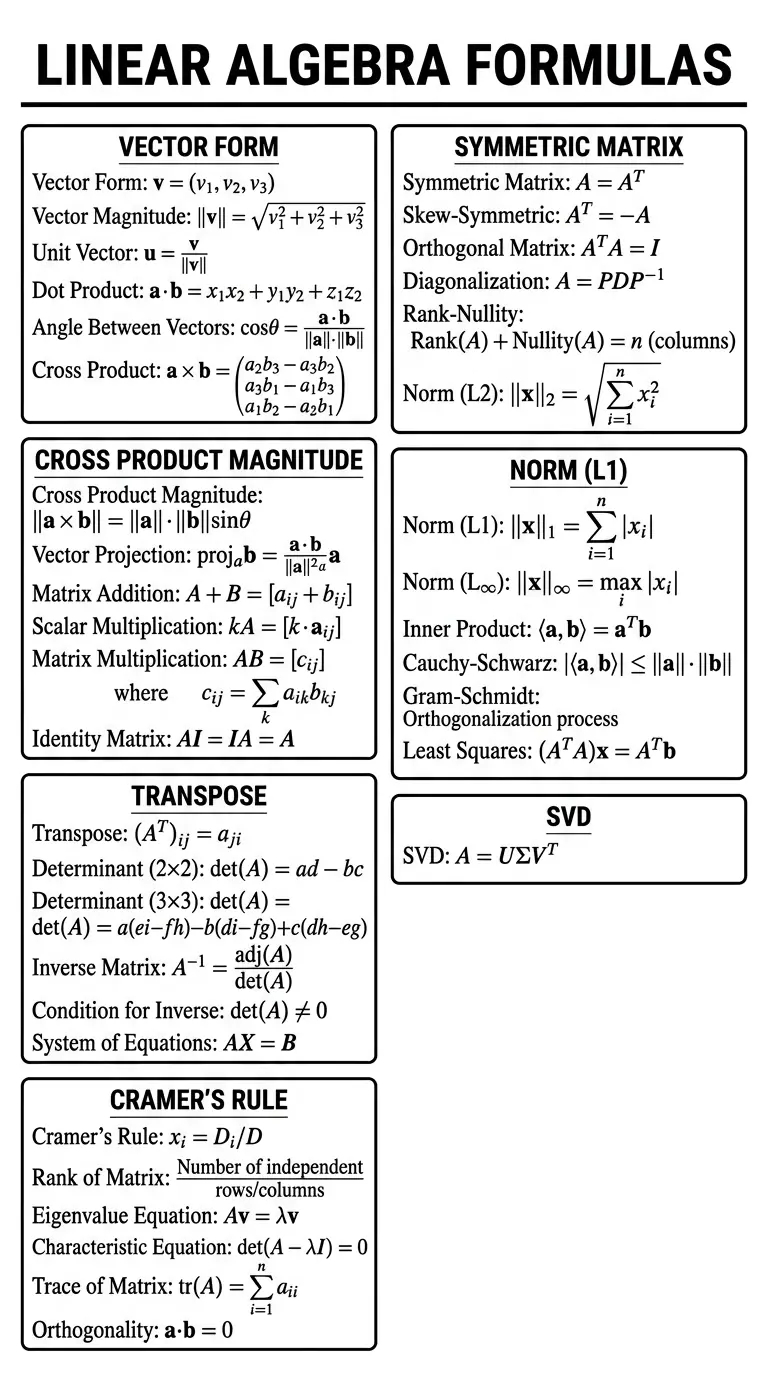
| Vector Form | v = (v₁, v₂, v₃) | Representation of vector |
| Vector Magnitude | v | |
| Unit Vector | v/ | v |
| Dot Product | a·b = x₁x₂ + y₁y₂ + z₁z₂ | Scalar product |
| Angle Between Vectors | cosθ = (a·b)/( | a |
| Cross Product | a×b | Vector perpendicular |
| Cross Product Magnitude | a×b | |
| Vector Projection | projₐb = (a·b/ | a |
| Matrix Addition | A + B | Add corresponding elements |
| Scalar Multiplication | kA | Multiply each element |
| Matrix Multiplication | AB | Row × Column rule |
| Identity Matrix | I | Multiplicative identity |
| Transpose | Aᵀ | Swap rows and columns |
| Determinant (2×2) | ad − bc | Matrix value |
| Determinant (3×3) | a(ei−fh)−b(di−fg)+c(dh−eg) | Expansion |
| Inverse Matrix | A⁻¹ = adj(A)/det(A) | Matrix inverse |
| Condition for Inverse | det(A) ≠ 0 | Invertibility |
| System of Equations | AX = B | Matrix form |
| Cramer’s Rule | x = Dx/D | Solve system |
| Rank of Matrix | Number of independent rows | Matrix rank |
| Eigenvalue Equation | Av = λv | Eigen relation |
| Characteristic Equation | det(A − λI) = 0 | Find eigenvalues |
| Trace of Matrix | Sum of diagonal elements | tr(A) |
| Orthogonality | a·b = 0 | Perpendicular vectors |
| Symmetric Matrix | A = Aᵀ | Mirror matrix |
| Skew-Symmetric | Aᵀ = −A | Opposite transpose |
| Orthogonal Matrix | AᵀA = I | Inverse equals transpose |
| Diagonalization | A = PDP⁻¹ | Matrix decomposition |
| Rank-Nullity | Rank + Nullity = Columns | Dimension rule |
| Norm (L2) | √Σx² | Vector length |
| Norm (L1) | Σ | x |
| Norm (L∞) | max | x |
| Inner Product | ⟨a,b⟩ | General dot product |
| Cauchy-Schwarz | a·b | |
| Gram-Schmidt | Orthogonalization process | Basis conversion |
| Least Squares | (AᵀA)x = Aᵀb | Best fit solution |
| SVD | A = UΣVᵀ | Matrix factorization |
Visited 11 times, 1 visit(s) today