

Commutative Property are the foundation of mathematics and play an important role in everyday life. Commutative Law include addition, subtraction, multiplication, and division, which are used in almost every calculation we perform daily. Whether you are counting money, measuring quantities, or solving simple problems, Commutative Law help make everything easier and more organized. Learning Commutation Rule at an early stage builds strong numerical skills and improves accuracy in calculations. Commutation Rule are also essential for understanding advanced topics like algebra, geometry, and calculus. Students who clearly understand Switching Property can solve problems faster and with more confidence.
In real life, Commutative Law are used in shopping, banking, budgeting, and many other daily tasks. Order Property also improve logical thinking and problem-solving ability. By practicing Switching Property regularly, learners can develop speed and accuracy. Commutation Rule are simple to learn but extremely powerful when applied correctly. Order Property form the base of all mathematical concepts and are necessary for both academic success and practical use in daily life.
Commutative Property Formula
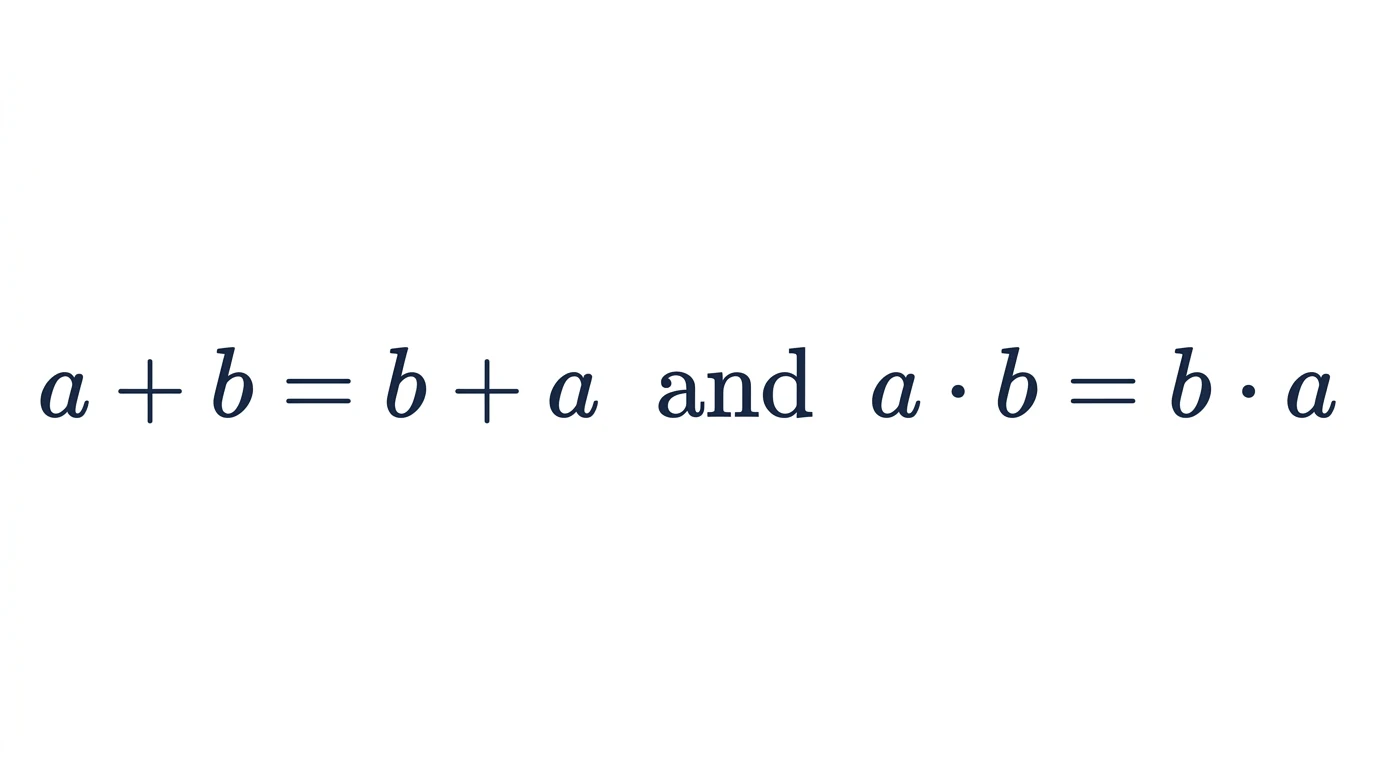
For addition:
a + b = b + a
For multiplication:
a × b = b × a
The order of operands does not affect the result for these operations.
Mathematical Proof of Commutative Property
1. COMMUTATIVE PROPERTY OF ADDITION (a + b = b + a)
Definition:
The commutative property of addition states that changing the order of addends does not change the sum.
Proof Idea:Visual proof using objects: Imagine 3 red balls and 5 blue balls. Counting red then blue gives 3 + 5 = 8. Counting blue then red gives 5 + 3 = 8. The total is the same regardless of counting order. On a number line: Starting at 0, moving right 3 then right 5 reaches the same point as moving right 5 then right 3.
Example:7 + 4 = 11 and 4 + 7 = 11. Whether you add 7 to 4 or 4 to 7, the sum is always 11.
Properties:Holds for all real numbers Extends to multiple terms: a + b + c can be rearranged in any order Fundamental to algebraic manipulation and simplification
2. COMMUTATIVE PROPERTY OF MULTIPLICATION (a × b = b × a)
Definition:
The commutative property of multiplication states that changing the order of factors does not change the product.
Proof Idea:Area model proof: A rectangle with length 4 and width 3 has area 4 × 3 = 12. Rotating the rectangle gives length 3 and width 4, with area 3 × 4 = 12. The area remains unchanged. Array proof: An array of 3 rows with 4 objects each contains 3 × 4 = 12 objects. Viewing it as 4 columns with 3 objects each gives 4 × 3 = 12 objects.
5 × 6 = 30 and 6 × 5 = 30. Whether you have 5 groups of 6 or 6 groups of 5, the total is 30.
Properties:Holds for all real numbers Extends to multiple factors: a × b × c can be rearranged in any order Crucial for algebraic manipulation: xy = yx allows flexible equation solving
3. NON-COMMUTATIVE OPERATIONS
Definition:
Subtraction and division do not have the commutative property; changing the order of operands changes the result.
Proof Idea:Counterexamples demonstrate non-commutativity. For subtraction: 5 – 3 = 2, but 3 – 5 = -2. The results differ. For division: 12 ÷ 4 = 3, but 4 ÷ 12 = 1/3. Again, the results differ. This shows that operation order matters for subtraction and division.
Example:Subtraction: 8 – 3 = 5, but 3 – 8 = -5. Division: 10 ÷ 2 = 5, but 2 ÷ 10 = 0.2. Order matters for these operations.
Properties:Subtraction: a – b ≠ b – a (except when a = b) Division: a ÷ b ≠ b ÷ a (except when a = b) These operations require careful attention to operand order
The commutative property applies only to addition and multiplication, allowing flexible rearrangement of terms and factors. Understanding which operations are commutative and which are not is essential for correct algebraic manipulation and problem solving.
Other Names of Commutative Property
Conclusion In conclusion, switching properties is essential for understanding numbers and solving everyday problems—the commutation rule helps in building strong mathematical skills and improving accuracy in calculations. With regular practice, the commutative law becomes easy and quick to apply in real-life situations. The symmetry property also supports learning in higher-level mathematics and other subjects. Whether in school or daily activities, the symmetry property remains useful and important. Mastering order property ensures better confidence, faster problem-solving, and a strong foundation for future mathematical learning.