

Finite Geometric Series Formula is an important concept in algebra that helps represent numbers using symbols and letters. A Geometric Series Sum Formula allows us to write mathematical ideas in a simple and flexible form. In a Geometric Series Sum Formula, letters like x, y, or z are used to show unknown values, while numbers and operations define relationships.
Learning Geometric Series Sum Formula makes it easier to understand patterns and solve equations. A GP Sum Formula is widely used in real-life situations such as calculating costs, measuring quantities, and solving problems step by step. By practicing GP Sum Formula, students develop logical thinking and problem-solving skills.
Finite Geometric Series Formula
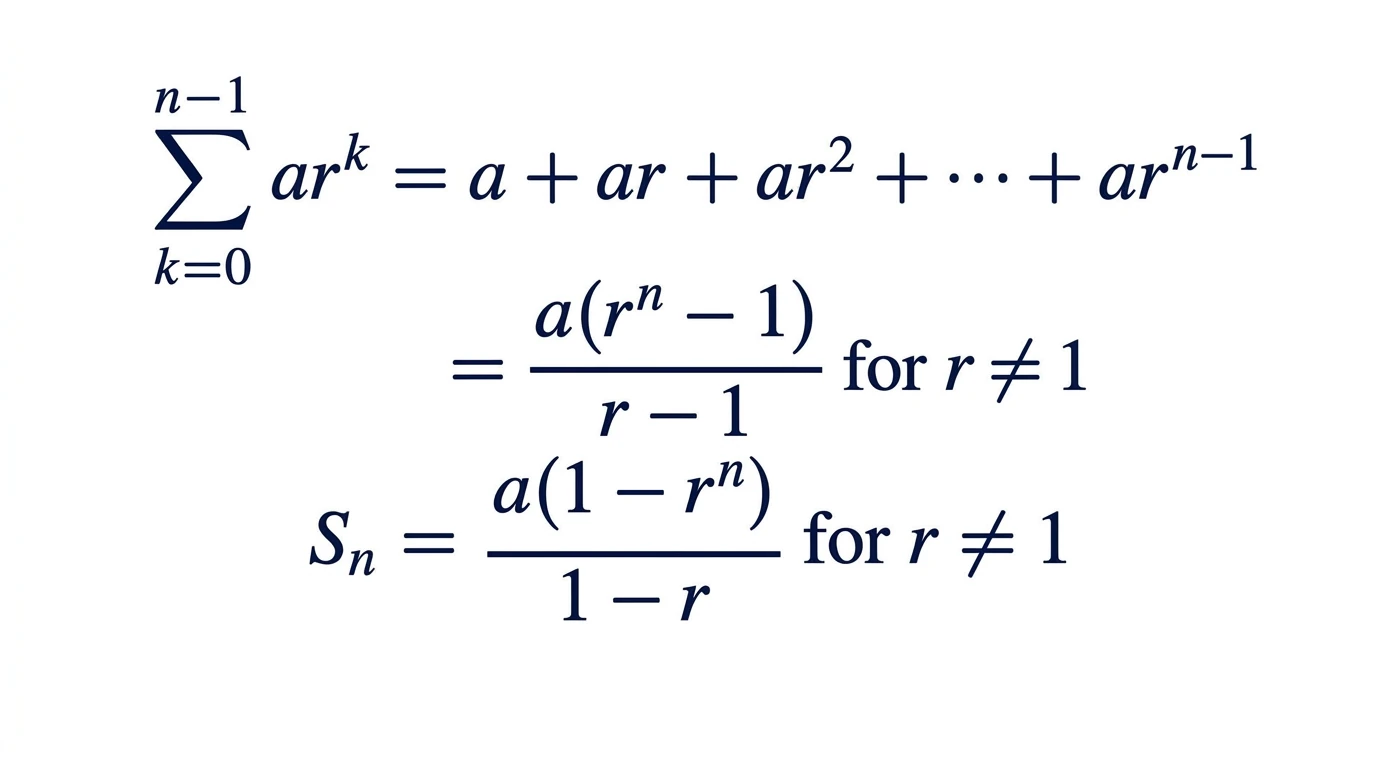
Finite Geometric Series Formula Formula
The sum of the first n terms of a geometric sequence is:
S_n = a_1(1 – r^n)/(1 – r) for r ≠ 1, or S_n = n·a_1
when r = 1, where a_1 is the first term and r is the common ratio.
Mathematical Proof of Finite Geometric Series Formula
1. FINITE GEOMETRIC SERIES SUM (S_n = a_1(1 – r^n)/(1 – r))
Definition:
A finite geometric series is the sum of the first n terms of a geometric sequence.
Proof Idea:Write S_n = a_1 + a_1·r + a_1·r² + … + a_1·r^(n-1). Multiply both sides by r: r·S_n = a_1·r + a_1·r² + a_1·r³ + … + a_1·r^n. Subtract the second equation from the first: S_n – r·S_n = a_1 – a_1·r^n. Factor: S_n(1 – r) = a_1(1 – r^n). Divide by (1 – r): S_n = a_1(1 – r^n)/(1 – r), valid when r ≠ 1. If r = 1, all terms equal a_1, so S_n = n·a_1.
Example:Sum of 3 + 6 + 12 + 24 + 48: n = 5, a_1 = 3, r = 2. S_5 = 3(1 – 2^5)/(1 – 2) = 3(1 – 32)/(-1) = 3(-31)/(-1) = 93.
Properties:Alternative form: S_n = a_1(r^n – 1)/(r – 1) for r ≠ 1
S_n = (a_1 – a_n·r)/(1 – r)
As n increases with |r| > 1, S_n grows without bound
The finite geometric series formula uses algebraic manipulation to eliminate all but the first and last terms, providing a direct computation of the sum without adding each term individually.
Other Names of Finite Geometric Series Formula
Finite Geometric Series Formula
A finite geometric series is the sum of a limited number of terms in a geometric sequence, where each term is obtained by multiplying the previous term by a constant value called the common ratio.
What Is a Finite Geometric Series?
A finite geometric series has the form:
a + ar + ar² + ar³ + … + arⁿ⁻¹
where:
a = first term
r = common ratio
n = number of terms
Example
2 + 6 + 18 + 54
This is a geometric series because each term is multiplied by 3 to get the next term.
- First term (a) = 2
- Common ratio (r) = 3
- Number of terms (n) = 4
Finite Geometric Series Formula
The sum of the first n terms of a geometric series is:
Sₙ = a(1 − rⁿ) / (1 − r)
This formula is used when r ≠ 1.
Alternative Form
The same formula can also be written as:
Sₙ = a(rⁿ − 1) / (r − 1)
Both forms produce the same result.
Derivation of the Formula
Consider the geometric series:
Sₙ = a + ar + ar² + … + arⁿ⁻¹
Multiply both sides by r:
rSₙ = ar + ar² + ar³ + … + arⁿ
Subtract the two equations:
Sₙ − rSₙ = a − arⁿ
Factor out Sₙ:
Sₙ(1 − r) = a(1 − rⁿ)
Divide both sides by 1 − r:
Sₙ = a(1 − rⁿ) / (1 − r)
Example 1
Find the Sum
2 + 6 + 18 + 54
Solution
Given:
- a = 2
- r = 3
- n = 4
Apply the formula:
S₄ = 2(1 − 3⁴) / (1 − 3)
S₄ = 2(1 − 81) / (−2)
S₄ = 2(−80) / (−2)
S₄ = 80
Answer
80
Example 2
Find the Sum
5 + 10 + 20 + 40 + 80
Solution
Given:
- a = 5
- r = 2
- n = 5
Using the formula:
S₅ = 5(1 − 2⁵) / (1 − 2)
S₅ = 5(1 − 32) / (−1)
S₅ = 5(−31) / (−1)
S₅ = 155
Answer
155
Example 3
Find the Sum
81 + 27 + 9 + 3 + 1
Solution
Given:
- a = 81
- r = 1/3
- n = 5
Apply the formula:
S₅ = 81[1 − (1/3)⁵] / [1 − (1/3)]
S₅ = 81(1 − 1/243) / (2/3)
S₅ = 121
Answer
121
Special Case: When r = 1
If the common ratio is 1, every term is the same.
For example:
5 + 5 + 5 + 5
The sum is simply:
Sₙ = na
where:
- n = number of terms
- a = first term
Applications of Finite Geometric Series
Finite geometric series are commonly used in:
- Finance and investment calculations
- Compound interest problems
- Population growth models
- Computer science algorithms
- Physics and engineering calculations
- Business forecasting
- Economics and statistics
Common Mistakes to Avoid
Using the Wrong Value of n
Make sure n represents the total number of terms, not the highest exponent.
Forgetting to Raise r to the nth Power
The formula requires rⁿ, not just r.
Incorrect Sign Handling
When using Sₙ = a(1 − rⁿ)/(1 − r), carefully simplify negative signs.
Applying the Formula When r = 1
Use Sₙ = na instead.
The finite geometric series formula provides a quick way to find the sum of a geometric sequence with a fixed number of terms. For a series with first term a, common ratio r, and n terms:
Sₙ = a(1 − rⁿ) / (1 − r)
This formula is widely used in mathematics, finance, engineering, and many real-world applications where quantities grow or decrease by a constant ratio.
Conclusion
In conclusion, the geometric summation formula plays a key role in learning algebra and understanding mathematical relationships. A Partial Geometric Series helps represent unknown values and makes problem-solving more flexible. With regular practice, partial geometric series become easy to use in equations and real-life situations. It also builds a strong base for advanced topics like functions and algebraic equations. Mastering Partial Geometric Series improves logical thinking and makes calculations more structured. Overall, the Geometric Series Sum Formula in algebra is an essential concept that helps students grow in mathematics and confidently handle different types of algebra problems.