

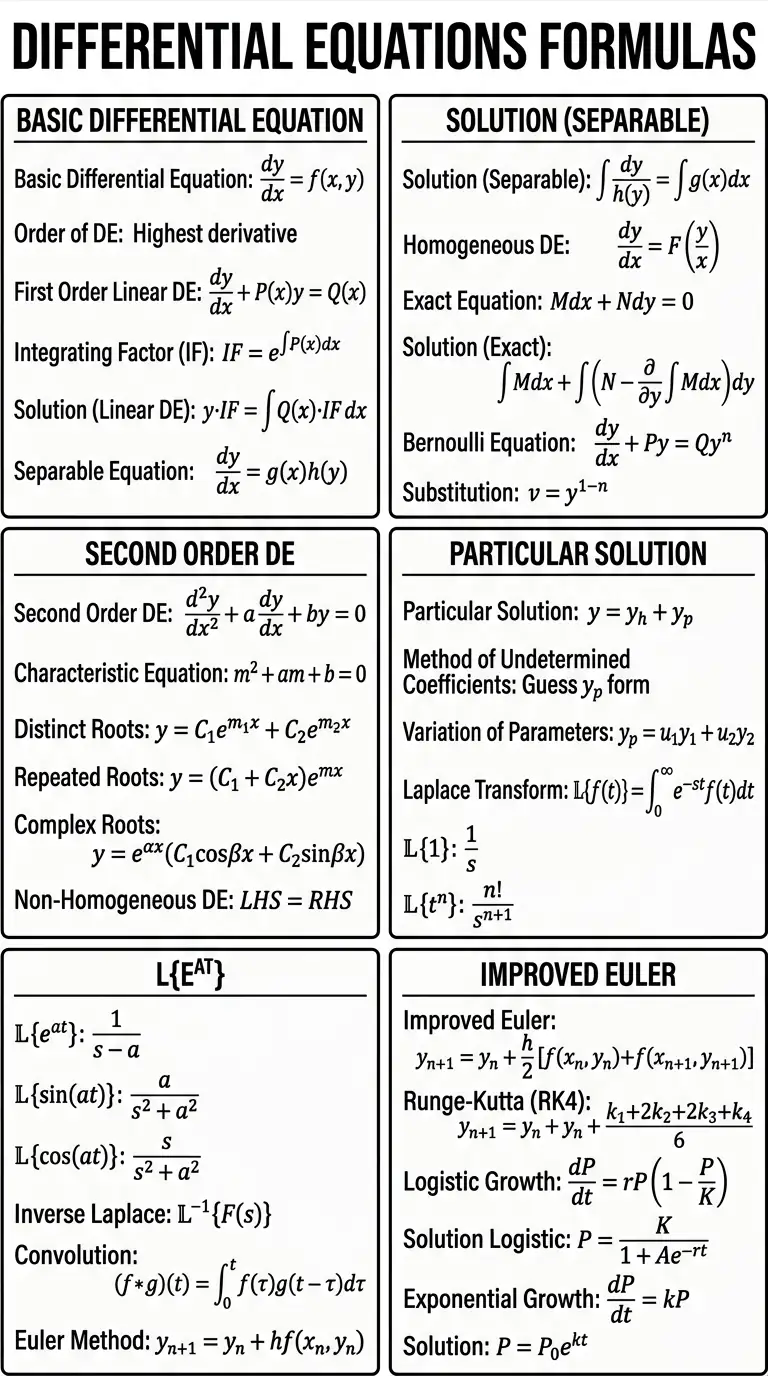
Differential Equations Formula Cheat Sheet
| Topic | Formula | Description |
|---|---|---|
| Basic Differential Equation | dy/dx = f(x, y) | General form |
| Order of DE | Highest derivative | Degree of equation |
| First Order Linear DE | dy/dx + P(x)y = Q(x) | Standard form |
| Integrating Factor (IF) | IF = e^(∫P(x)dx) | Solve linear DE |
| Solution (Linear DE) | y·IF = ∫Q(x)·IF dx | General solution |
| Separable Equation | dy/dx = g(x)h(y) | Separate variables |
| Solution (Separable) | ∫dy/h(y) = ∫g(x)dx | Integrate both sides |
| Homogeneous DE | dy/dx = F(y/x) | Substitution y = vx |
| Exact Equation | Mdx + Ndy = 0 | Exact if dM/dy = dN/dx |
| Solution (Exact) | ∫Mdx + ∫(N − ∂/∂y ∫Mdx)dy | Solve exact DE |
| Bernoulli Equation | dy/dx + Py = Qyⁿ | Nonlinear DE |
| Substitution | v = y^(1−n) | Convert to linear |
| Second Order DE | d²y/dx² + a dy/dx + by = 0 | General form |
| Characteristic Equation | m² + am + b = 0 | Solve roots |
| Distinct Roots | y = C₁e^(m₁x) + C₂e^(m₂x) | General solution |
| Repeated Roots | y = (C₁ + C₂x)e^(mx) | Solution form |
| Complex Roots | y = e^(αx)(C₁cosβx + C₂sinβx) | Oscillatory solution |
| Non-Homogeneous DE | LHS = RHS | Particular solution needed |
| Particular Solution | y = yₕ + yₚ | Complete solution |
| Method of Undetermined Coefficients | Guess yₚ form | Solve RHS type |
| Variation of Parameters | yₚ = u₁y₁ + u₂y₂ | General method |
| Laplace Transform | L{f(t)} = ∫₀^∞ e^(-st)f(t)dt | Transform method |
| L{1} | 1/s | Basic transform |
| L{tⁿ} | n!/sⁿ⁺¹ | Power function |
| L{e^(at)} | 1/(s−a) | Exponential |
| L{sin(at)} | a/(s² + a²) | Trig transform |
| L{cos(at)} | s/(s² + a²) | Trig transform |
| Inverse Laplace | L⁻¹{F(s)} | Back to time domain |
| Convolution | (f*g)(t) = ∫₀ᵗ f(τ)g(t−τ)dτ | Integral relation |
| Euler Method | yₙ₊₁ = yₙ + h f(xₙ,yₙ) | Numerical method |
| Improved Euler | yₙ₊₁ = yₙ + h/2 [f(xₙ,yₙ)+f(xₙ₊₁,yₙ₊₁)] | Better approx |
| Runge-Kutta (RK4) | yₙ₊₁ = yₙ + (k₁+2k₂+2k₃+k₄)/6 | High accuracy |
| Logistic Growth | dP/dt = rP(1 − P/K) | Population model |
| Solution Logistic | P = K / (1 + Ae^(−rt)) | Growth formula |
| Exponential Growth | dP/dt = kP | Growth model |
| Solution | P = P₀e^(kt) | Exponential solution |
Visited 8 times, 1 visit(s) today