

Dividing Complex Numbers is an important concept in algebra that helps represent numbers using symbols and letters. A Complex Division allows us to write mathematical ideas in a simple and flexible form. In a Complex Division, letters like x, y, or z are used to show unknown values, while numbers and operations define relationships. Learning Complex Division makes it easier to understand patterns and solve equations. A Quotient Rule is widely used in real-life situations such as calculating costs, measuring quantities, and solving problems step by step. By practicing Quotient Rule, students develop logical thinking and problem-solving skills.
Dividing Complex Numbers
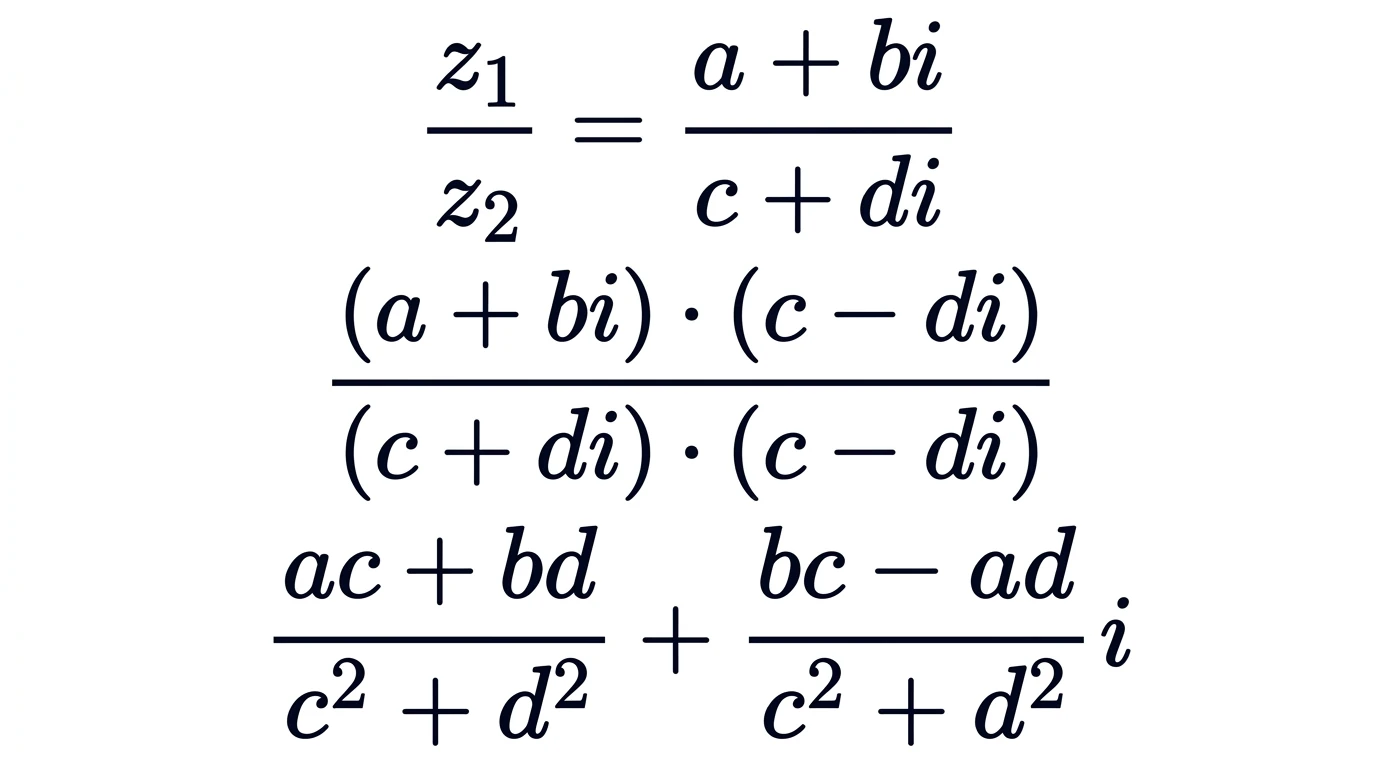
Dividing Complex Numbers Formula
To divide complex numbers, multiply numerator and denominator by the conjugate of the denominator:
(a + bi)/(c + di) = [(a + bi)(c – di)]/[(c + di)(c – di)]
[(a + bi)(c – di)]/[(c + di)(c – di)] = [(ac + bd) + (bc – ad)i]/(c² + d²).
Mathematical Proof of Dividing Complex Numbers
1. DIVIDING COMPLEX NUMBERS ((a + bi)/(c + di) = [(ac + bd) + (bc – ad)i]/(c² + d²))
Definition:
Division of complex numbers is accomplished by multiplying both numerator and denominator by the complex conjugate of the denominator to obtain a real denominator.
Proof Idea:To divide (a + bi) by (c + di), multiply both numerator and denominator by the conjugate (c – di): [(a + bi)(c – di)]/[(c + di)(c – di)]. The denominator becomes (c + di)(c – di) = c² + d², which is real. The numerator expands to: (a + bi)(c – di) = ac – adi + bci – bdi² = ac + bd + (bc – ad)i. Therefore the result is [(ac + bd) + (bc – ad)i]/(c² + d²) = (ac + bd)/(c² + d²) + (bc – ad)/(c² + d²)·i.
Example:(3 + 2i)/(1 – i) = [(3 + 2i)(1 + i)]/[(1 – i)(1 + i)] = [3 + 3i + 2i + 2i²]/[1 – i²] = [3 + 5i – 2]/[1 + 1] = (1 + 5i)/2 = 1/2 + (5/2)i
Properties:Division by zero (0 + 0i) is undefined
For z ≠ 0, z·(1/z) = 1
|z/w| = |z|/|w| for w ≠ 0
(z/w)* = z*/w* for w ≠ 0
Division of complex numbers leverages the conjugate to eliminate imaginary parts from denominators, transforming division into multiplication and producing a standard form result that maintains all algebraic properties.
Other Names of Dividing Complex Numbers
Divide Complex Numbers Using Conjugates
Dividing complex numbers becomes simple when you use the conjugate of the denominator. This method eliminates the imaginary part from the denominator and converts it into a real number.
What Is a Conjugate?
For a complex number a + bi, its conjugate is a − bi.
Examples:
-
Conjugate of 3 + 4i is 3 − 4i
-
Conjugate of 5 − 2i is 5 + 2i
Steps to Divide Complex Numbers Using Conjugates
Suppose you want to divide:
(a + bi) / (c + di)
Step 1: Find the Conjugate of the Denominator
The conjugate of c + di is:
c − di
Step 2: Multiply the Numerator and Denominator by the Conjugate
[(a + bi) / (c + di)] × [(c − di) / (c − di)]
Step 3: Simplify the Denominator
When a complex number is multiplied by its conjugate:
(c + di)(c − di) = c² + d²
The denominator becomes a real number.
Step 4: Expand the Numerator
Multiply the terms and combine like terms.
Step 5: Write the Answer in Standard Form
Express the result as:
x + yi
Example 1
Problem
Divide:
(2 + 3i) / (1 − 2i)
Solution
Multiply the numerator and denominator by the conjugate of the denominator:
[(2 + 3i) / (1 − 2i)] × [(1 + 2i) / (1 + 2i)]
Expand the numerator:
(2 + 3i)(1 + 2i)
= 2 + 4i + 3i + 6i²
= 2 + 7i − 6
= −4 + 7i
Expand the denominator:
(1 − 2i)(1 + 2i)
= 1 − (2i)²
= 1 + 4
= 5
Therefore:
(−4 + 7i) / 5
= −4/5 + (7/5)i
Answer
−4/5 + (7/5)i
Example 2
Problem
Divide:
(4 − i) / (2 + 3i)
Solution
Multiply by the conjugate of the denominator:
[(4 − i) / (2 + 3i)] × [(2 − 3i) / (2 − 3i)]
Expand the numerator:
(4 − i)(2 − 3i)
= 8 − 12i − 2i + 3i²
= 8 − 14i − 3
= 5 − 14i
Expand the denominator:
(2 + 3i)(2 − 3i)
= 4 − (3i)²
= 4 + 9
= 13
Therefore:
(5 − 14i) / 13
= 5/13 − (14/13)i
Answer
5/13 − (14/13)i
Formula for Dividing Complex Numbers
For any two complex numbers:
(a + bi) / (c + di)
The result can be written as:
[(ac + bd) / (c² + d²)] + [(bc − ad) / (c² + d²)]i
Using the conjugate of the denominator is the standard method for dividing complex numbers. Multiplying by the conjugate removes the imaginary part from the denominator, making the expression easier to simplify and write in standard form.
Conclusion
In conclusion, Division by Conjugate plays a key role in learning algebra and understanding mathematical relationships. A Complex Division helps represent unknown values and makes problem-solving more flexible. With regular practice, Complex Division becomes easy to use in equations and real-life situations. It also builds a strong foundation for advanced topics such as functions and algebraic equations. Mastering Complex Division improves logical thinking and makes calculations more structured. Overall, Complex Division in algebra is an essential concept that helps students grow in mathematics and confidently tackle a variety of algebra problems.