

Imaginary Unit is an important concept in algebra that helps represent numbers using symbols and letters. A Unit Imaginary Number allows us to write mathematical ideas in a simple and flexible form. In a Unit Imaginary Number, letters like x, y, or z are used to show unknown values, while numbers and operations define relationships. Learning Unit Imaginary Number makes it easier to understand patterns and solve equations. A Imaginary One is widely used in real-life situations such as calculating costs, measuring quantities, and solving problems step by step. By practicing Imaginary One, students develop logical thinking and problem-solving skills.
Imaginary Unit Formula
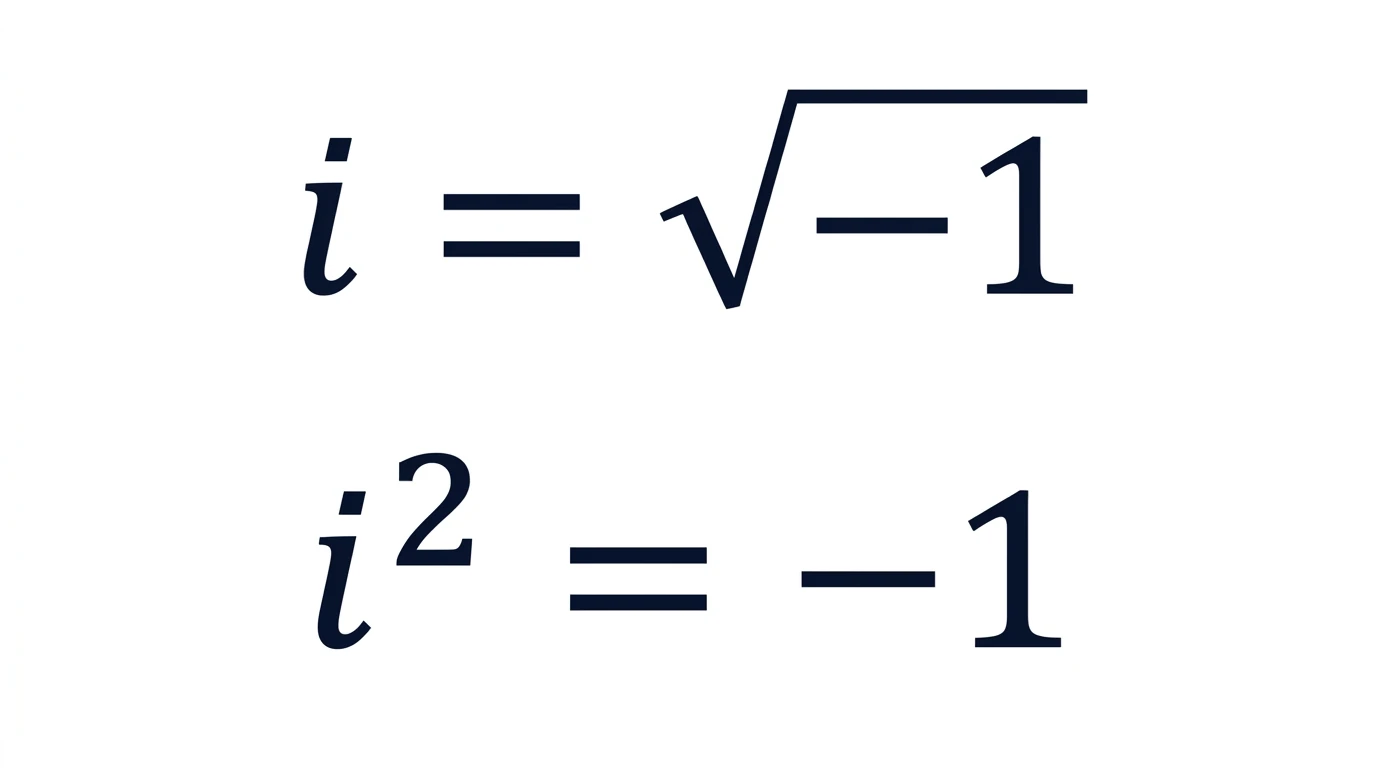
Imaginary Unit Formula
The imaginary unit i is defined as the square root of negative one:
i = √(-1),
which means i² = -1.
Mathematical Proof of the Imaginary Unit
1. IMAGINARY UNIT (i = √(-1), i² = -1)
Definition:
The imaginary unit i is a mathematical constant representing the square root of negative one, extending the real number system.
Proof Idea:By definition, i is the number that satisfies i² = -1. This cannot be any real number since squaring any real number yields a non-negative result. We define i axiomatically to satisfy this property, creating the imaginary numbers. Powers of i cycle: i¹ = i, i² = -1, i³ = i²·i = -i, i⁴ = i²·i² = 1, and then the pattern repeats.
Example:i² = -1, i³ = -i, i⁴ = 1, i⁵ = i. Also √(-9) = √(9·(-1)) = 3i
Properties:i⁴ⁿ = 1 for any integer n
i⁴ⁿ⁺¹ = i, i⁴ⁿ⁺² = -1, i⁴ⁿ⁺³ = -i
1/i = -i since i·(-i) = -i² = 1
The imaginary unit i extends mathematics beyond real numbers, enabling solutions to equations like x² + 1 = 0 and forming the foundation for complex numbers and their applications in engineering and physics.
Other Names of Imaginary Unit
Imaginary Unit in Mathematics
The imaginary unit is a special mathematical concept represented by the symbol i. It is defined as the square root of −1 and forms the foundation of complex numbers.
What Is the Imaginary Unit?
The imaginary unit i is defined as:
i = √−1
In the real number system, no number squared equals −1. For example:
-
1² = 1
-
(−1)² = 1
Since no real number satisfies the equation x² = −1, mathematicians introduced the imaginary unit i.
Why Is the Imaginary Unit Important?
The imaginary unit allows mathematicians to solve equations that have no real solutions. For example:
x² + 1 = 0
Rearranging gives:
x² = −1
Taking the square root of both sides:
x = ±i
Without the imaginary unit, this equation would have no solution in the real number system.
Powers of the Imaginary Unit
The powers of i follow a repeating pattern:
-
i¹ = i
-
i² = −1
-
i³ = −i
-
i⁴ = 1
-
i⁵ = i
-
i⁶ = −1
The pattern repeats every four powers.
Quick Reference Table
| Power | Value |
|---|---|
| i¹ | i |
| i² | −1 |
| i³ | −i |
| i⁴ | 1 |
| i⁵ | i |
| i⁶ | −1 |
Imaginary Unit and Complex Numbers
A complex number consists of a real part and an imaginary part:
a + bi
where:
-
a is the real part
-
b is the imaginary coefficient
-
i is the imaginary unit
Examples of Complex Numbers
3 + 2i
5 − i
−4 + 7i
8i
Operations Involving the Imaginary Unit
Addition
(3 + 2i) + (4 + 5i)
= 7 + 7i
Subtraction
(6 + 4i) − (2 + i)
= 4 + 3i
Multiplication
(2 + i)(3 + 2i)
= 6 + 4i + 3i + 2i²
= 6 + 7i − 2
= 4 + 7i
Real-World Applications of the Imaginary Unit
The imaginary unit is widely used in many fields, including:
- Electrical engineering
- Signal processing
- Quantum mechanics
- Control systems
- Computer graphics
- Wave analysis
- Telecommunications
These applications rely on complex numbers to model and solve real-world problems efficiently.
Common Mistakes to Avoid
Confusing i with a Variable
The symbol i is a fixed mathematical constant, not an unknown variable.
Forgetting That i² = −1
A common error is treating i² as i. Always remember:
i² = −1
Incorrectly Simplifying Square Roots
√−9 = 3i
not simply 3.
Key Takeaway
The imaginary unit (i) is defined as the square root of −1 and serves as the building block of complex numbers. It enables mathematicians, scientists, and engineers to solve problems that cannot be addressed using only real numbers, making it one of the most important concepts in advanced mathematics.
Conclusion
In conclusion, i Constant plays a key role in learning algebra and understanding mathematical relationships. A i Constant helps represent unknown values and makes problem-solving more flexible. With regular practice, i Constant becomes easy to use in equations and real-life situations. It also builds a strong base for advanced topics like functions and algebraic equations. Mastering i Constant improves logical thinking and makes calculations more structured. Overall, Unit Imaginary Number in algebra is an essential concept that helps students grow in mathematics and confidently handle different types of algebra problems.