

Arithmetic Series Formula is an important concept in algebra that helps represent numbers using symbols and letters. A Arithmetic Progression Sum allows us to write mathematical ideas in a simple and flexible form. In a Arithmetic Progression Sum, letters like x, y, or z are used to show unknown values, while numbers and operations define relationships. Learning Arithmetic Progression Sum makes it easier to understand patterns and solve equations. An AP Sum Formula is widely used in real-life situations such as calculating costs, measuring quantities, and solving problems step by step. By practicing AP Sum Formula, students develop logical thinking and problem-solving skills.
Arithmetic Series Formula
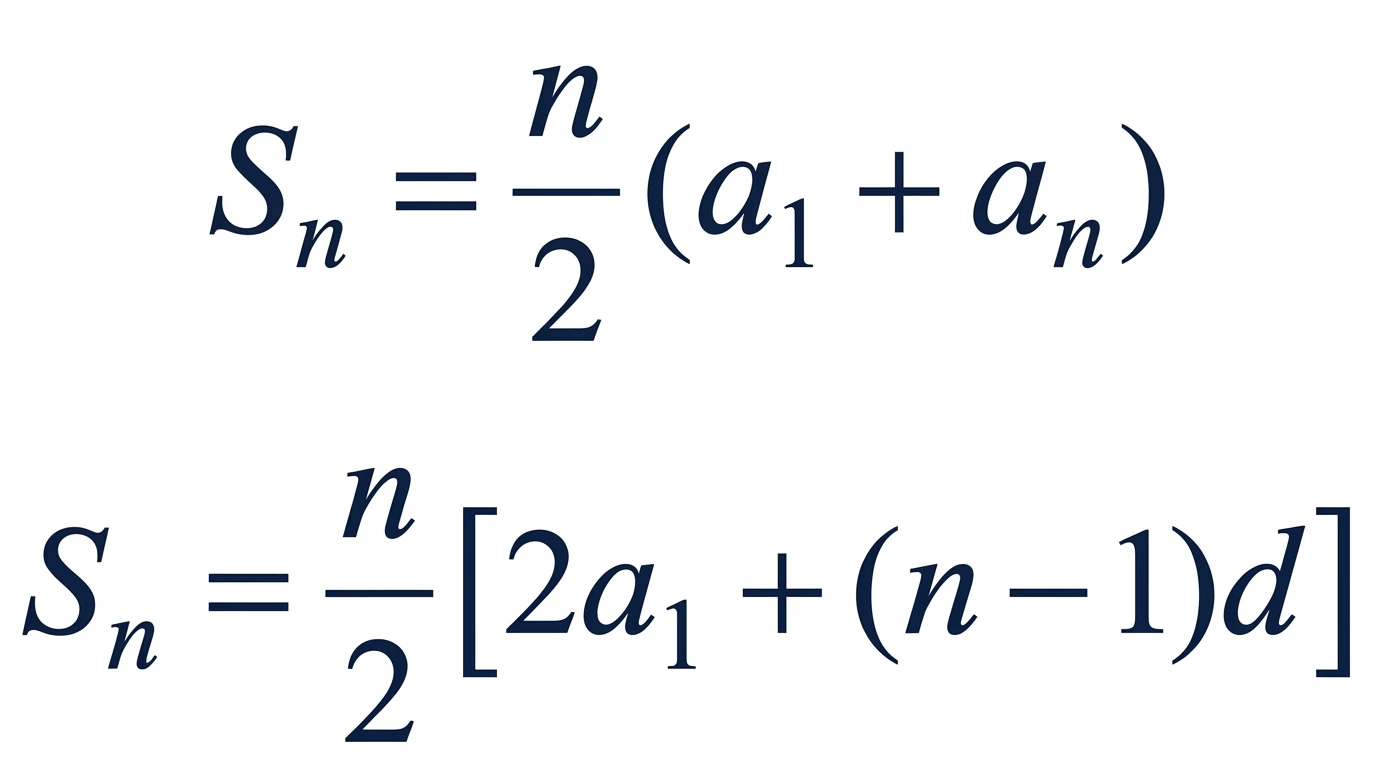
Arithmetic Series Formula Formula
The sum of the first n terms of an arithmetic sequence is:
S_n = (n/2)(a_1 + a_n)
or equivalently
S_n = (n/2)(2a_1 + (n-1)d)
where a_1 is the first term, a_n is the nth term, d is the common difference.
Mathematical Proof of Arithmetic Series Formula
1. ARITHMETIC SERIES SUM (S_n = (n/2)(a_1 + a_n))
Definition:
An arithmetic series is the sum of terms in an arithmetic sequence.
Proof Idea:Write S_n = a_1 + a_2 + … + a_(n-1) + a_n. Write the same sum in reverse: S_n = a_n + a_(n-1) + … + a_2 + a_1. Add these two equations term by term: 2S_n = (a_1 + a_n) + (a_2 + a_(n-1)) + … + (a_n + a_1). Each pair sums to (a_1 + a_n), and there are n such pairs. Thus 2S_n = n(a_1 + a_n), so S_n = (n/2)(a_1 + a_n). Substituting a_n = a_1 + (n-1)d gives the alternate form.
Example:Sum of 2 + 5 + 8 + 11 + 14: n = 5, a_1 = 2, a_5 = 14. S_5 = (5/2)(2 + 14) = (5/2)(16) = 40.
Properties:Average of first and last term times number of terms
S_n – S_(n-1) = a_n
Works for any arithmetic progression
The arithmetic series formula efficiently computes the sum by recognizing that pairs of equidistant terms from the ends sum to a constant, giving the average term multiplied by the count.
Other Names of Arithmetic Series Formula
An arithmetic series is the sum of the terms of an arithmetic sequence, where the difference between consecutive terms is constant.
Formula for the Sum of an Arithmetic Series
If:
- aa = first term
- dd = common difference
- nn = number of terms
then the sum of the first nn terms is:
Sn=n2[2a+(n−1)d]
Alternative Formula
If the first term aa and the last term ll are known:
Sn = n2(a+l)
Example 1
Find the sum of:
2+5+8+11+14
Here:
- a=2a = 2
- d=3d = 3
- n=5n = 5
Using the formula:
S5=52[2(2)+(5−1)(3)]
S5=40
Answer: 40
Example 2
Find the sum of the first 20 terms of the arithmetic sequence:
3,7,11,15,…3, 7, 11, 15, \dots
Here:
- a=3a = 3
- d=4d = 4
- n=20n = 20
Using the formula:
S20=202[2(3)+(20−1)(4)]
S20=10[6+76]
S20=10(82)
S20=820
Answer: 820
Applications of Arithmetic Series
Arithmetic series are used in:
- Finance and budgeting
- Construction and engineering measurements
- Computer algorithms
- Business forecasting
- Statistical calculations
Summary
The arithmetic series formula is:
Sn=n2[2a+(n−1)d]S_n = \frac{n}{2}\left[2a + (n-1)d\right]
or
Sn=n2(a+l)S_n = \frac{n}{2}(a + l)
It allows you to quickly find the sum of any arithmetic sequence without adding every term individually.
Conclusion
In conclusion, Linear Series Sum plays a key role in learning algebra and understanding mathematical relationships. A Arithmetic Summation Formula helps represent unknown values and makes problem-solving more flexible. With regular practice, Arithmetic Summation Formula becomes easy to use in equations and real-life situations. It also builds a strong base for advanced topics like functions and algebraic equations. Mastering Arithmetic Summation Formula improves logical thinking and makes calculations more structured. Overall, Arithmetic Progression Sum in algebra is an essential concept that helps students grow in mathematics and confidently handle different types of algebra problems.