
Basic Arithmetic Operations Formula
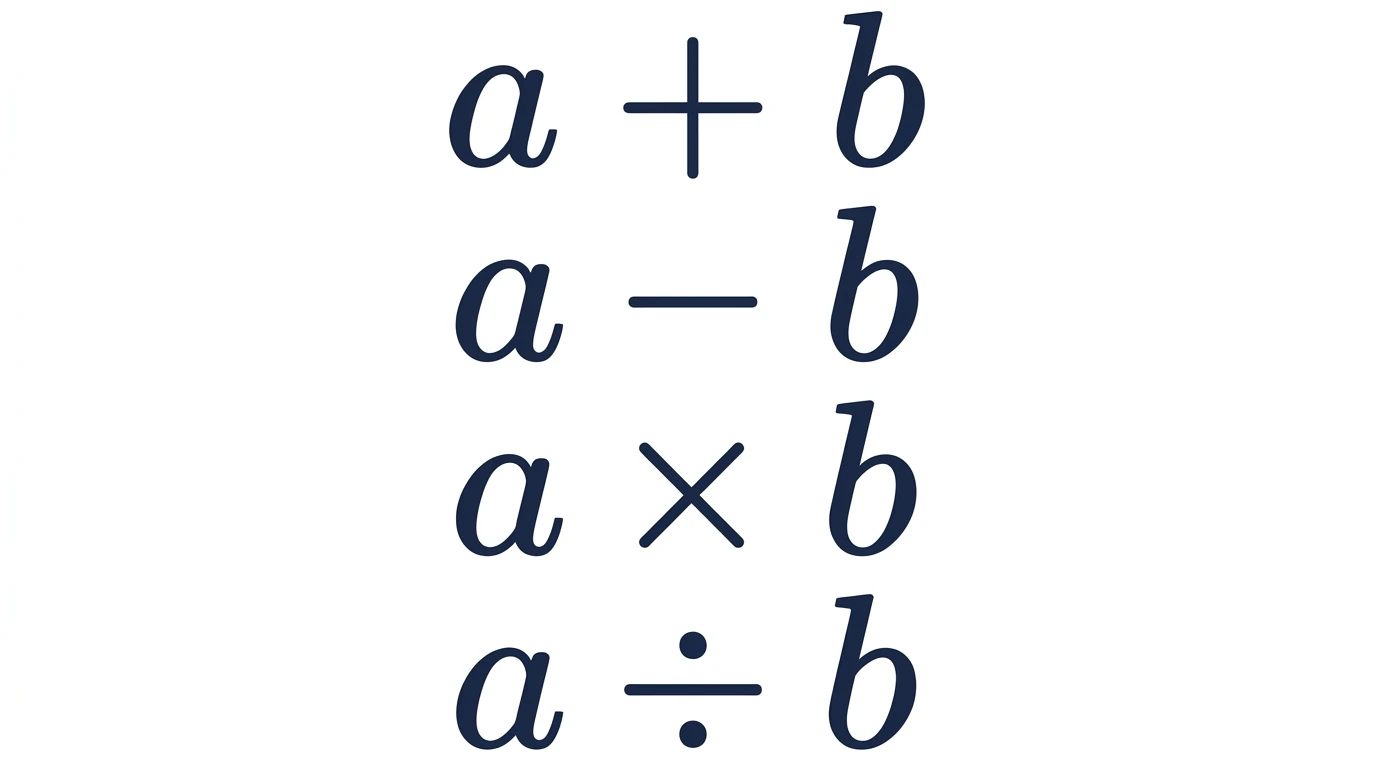
The four fundamental operations are: Addition (a + b), subtraction (a – b), multiplication (a × b), and division (a ÷ b). These operations form the foundation of all arithmetic.
Mathematical Proof of Basic Arithmetic Operations
1. ADDITION (a + b)
Definition:
Addition means combining two quantities to find their total sum.
Using a number line: Start at point ‘a’ and move ‘b’ units to the right. The ending position represents ‘a + b’. This demonstrates that addition increases a quantity by another amount.
Example:5 + 3 = 8. Starting at 5 on the number line, move 3 steps right to reach 8.
Properties:Commutative: a + b = b + a Associative: (a + b) + c = a + (b + c) Identity: a + 0 = a Inverse: a + (-a) = 0
2. SUBTRACTION (a – b)
Definition:
Subtraction means finding the difference between two quantities by removing one amount from another.
Proof Idea:Using a number line: Start at point ‘a’ and move ‘b’ units to the left. The ending position represents ‘a – b’. Subtraction is the inverse operation of addition, as a – b + b = a.
Example:8 – 3 = 5. Starting at 8 on the number line, move 3 steps left to reach 5.
Properties:Not commutative: a – b ≠ b – a (in general) Not associative: (a – b) – c ≠ a – (b – c) (in general) Identity: a – 0 = a Relation to addition: a – b = a + (-b)
3. MULTIPLICATION (a × b)
Definition:
Multiplication means repeated addition of a quantity, where ‘a × b’ represents adding ‘a’ to itself ‘b’ times.
Proof Idea:Multiplication as repeated addition: 4 × 3 = 4 + 4 + 4 = 12. Using an area model: a rectangle with length ‘a’ and width ‘b’ has area ‘a × b’, showing multiplication combines dimensions.
Example:4 × 3 = 12. This means three groups of 4, or 4 + 4 + 4 = 12.
Properties:Commutative: a × b = b × a Associative: (a × b) × c = a × (b × c) Identity: a × 1 = a Zero property: a × 0 = 0 Distributive: a × (b + c) = (a × b) + (a × c)
4. DIVISION (a ÷ b)
Definition:
Division means splitting a quantity into equal parts, where ‘a ÷ b’ represents dividing ‘a’ into ‘b’ equal groups.
Proof Idea:Division as inverse of multiplication: If a × b = c, then c ÷ b = a. Example: Since 3 × 4 = 12, we know 12 ÷ 4 = 3. Division answers the question: how many groups of ‘b’ fit into ‘a’?
Example:12 ÷ 4 = 3. This means 12 split into 4 equal groups gives 3 in each group.
Properties:Not commutative: a ÷ b ≠ b ÷ a (in general) Not associative: (a ÷ b) ÷ c ≠ a ÷ (b ÷ c) (in general) Identity: a ÷ 1 = a Relation to multiplication: a ÷ b = a × (1/b) Division by zero is undefined
These four operations work together as paired inverses: addition with subtraction and multiplication with division. All higher mathematics builds upon these fundamental operations, which can be visualised through number lines, grouping, and area models.